Singapore: From Maritime Emporium to Global Hub
How a swampy trading post kept reinventing itself into one of the richest nations on earth.
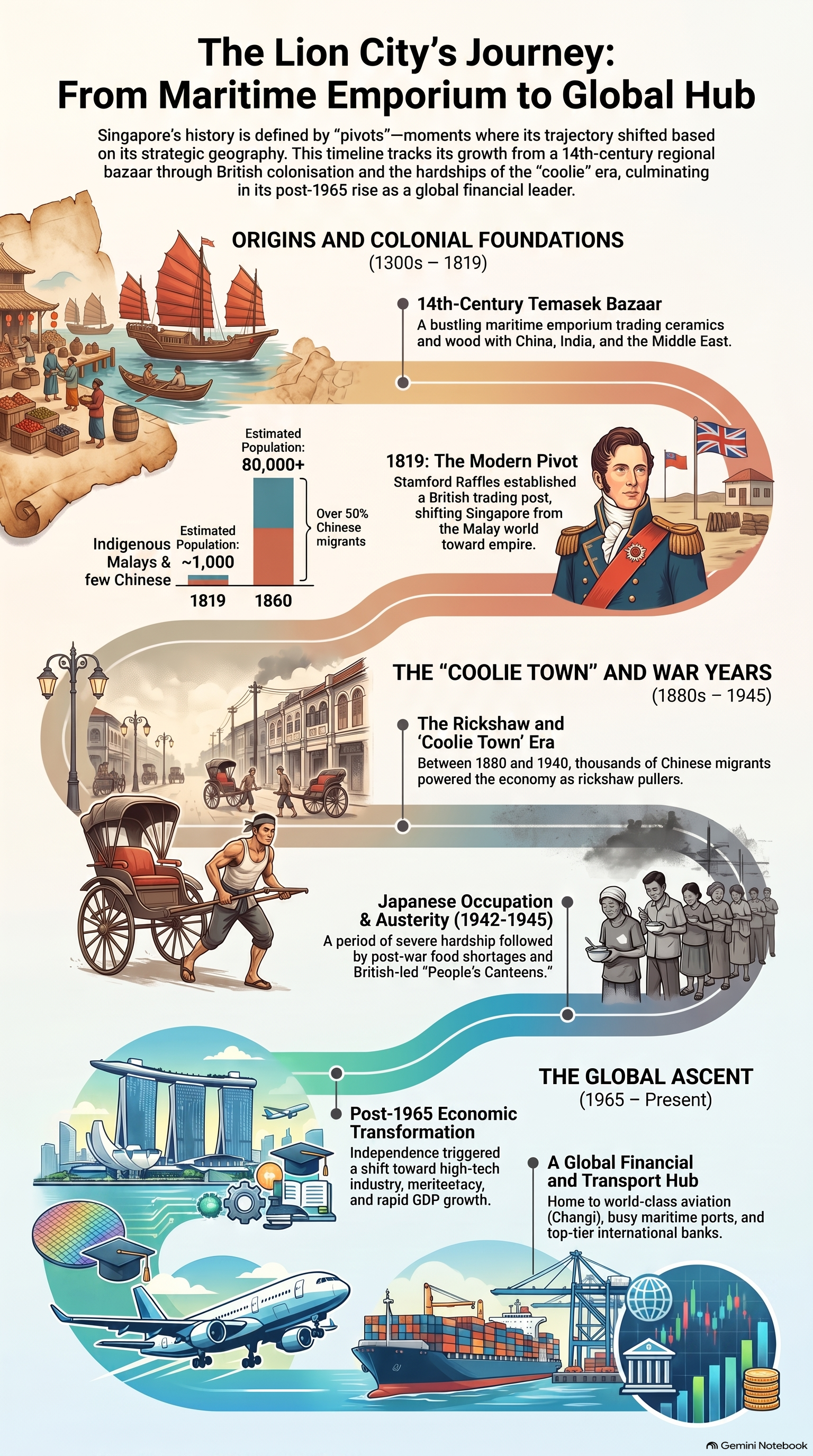
Singapore’s founding myth is a sleepy fishing village that Stamford Raffles transformed in 1819 — a tidy story that happens to be mostly wrong. Long before the British arrived, the island sat astride the trade routes threading the Strait of Malacca, a natural waypoint between the Indian Ocean and the South China Sea, and it had been a regional port on and off for centuries. What actually defines Singapore’s history isn’t a single origin but a series of pivots: from precolonial trading post to British free port, through the brutal “coolie” era and the trauma of wartime occupation, to a shock 1965 independence nobody especially wanted, and then the improbable climb to a global financial centre with almost no natural resources of its own. Geography handed it a position; what it did with that position — reinventing its role each time the world shifted around it — is the actual story.